What are you actually trying to fix here? Better skin, maybe thicker hair, and somewhere along the way someone mentioned peptides like they’re the obvious answer. Okay, fair enough. But before any money changes hands, you need to know exactly what you’re buying, who’s actually accountable for it, and what your options are if things don’t go to plan. That’s really what this guide comes down to.
Four names keep coming up in this space: GHK-Cu, AHK-Cu, SNAP-8, and melanotan II. Treat them like four different products on a shelf, because they are not interchangeable, and the seller who tells you they’re all roughly the same thing is the seller you walk away from.
Here’s the state of play before you buy anything: out of those four compounds, exactly one has anything resembling a decent human trial behind it. One. That’s your starting point, not the marketing copy on the label.
First question: is any of this “approved,” so I know it’s safe?
No. None of the four is an FDA-approved drug for skin or hair, full stop. The copper peptide creams and SNAP-8 serums you see on shelves are sold as cosmetics, and cosmetics don’t go through FDA premarket approval, the agency says so itself on its own page. So there’s no green light waiting for you here. Nobody’s checked the box. You’re the one doing the checking, which is exactly why this guide exists.
Which one actually has evidence behind it, and how much?
GHK-Cu, and even then, keep your expectations in check. Here’s the actual data, not the sales pitch.
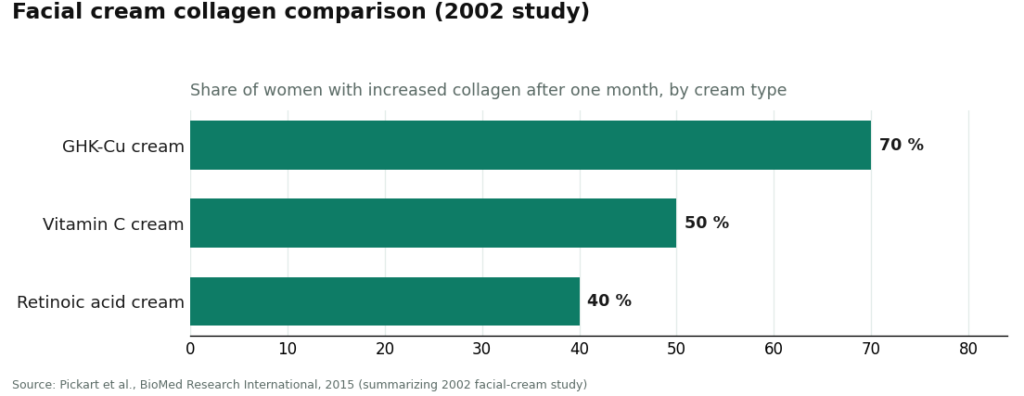
The number everyone quotes comes from a 2002 facial-cream study, written up in a 2015 review in BioMed Research International: a GHK-Cu cream increased collagen in about 70% of women after a month, against 50% for a vitamin C cream and 40% for retinoic acid. Three creams, one winner, and it’s a modest one. That same review notes something genuinely interesting about the biology: plasma GHK levels drop from around 200 ng/mL at age 20 to about 80 ng/mL by 60. That’s real, and it’s probably why the copper peptide idea took off in the first place.
But don’t take this as settled science. A 2006 randomized controlled trial in Archives of Facial Plastic Surgery tested a topical copper tripeptide complex after laser resurfacing and found no measurable improvement, just happier patients. So even the best-evidenced compound on this list has a mixed record. File GHK-Cu under “best of a weak field, genuinely useful for topical skin use, don’t expect miracles.”
AHK-Cu is thinner still. There’s a 2007 study in Archives of Pharmaceutical Research showing it grew hair follicles and multiplied dermal papilla cells, in a lab dish. That’s it. No large human trials for hair loss. It might be promising. It hasn’t been tested on people at any scale.
SNAP-8 has a famous wrinkle-reduction number floating around, and it comes from manufacturer promotional material, not independent trial data. Every real study on it tests SNAP-8 mixed in with other actives, so nobody can actually isolate what SNAP-8 itself is doing. Worse, a 2025 review in the International Journal of Molecular Sciences raises doubts about whether this whole peptide family even gets through the skin in meaningful amounts. So you’ve got a marketing number, no clean data, and a penetration problem. Not a great combination.
Now, the one you need to hear about separately: melanotan II
This one gets lumped in with the others on a lot of lists, and that’s the single worst thing a beginner can let happen to their judgment. Melanotan II is an injectable that darkens your skin by working on melanocortin receptors. It’s not approved. And unlike the other three, the numbers attached to it aren’t efficacy numbers, they’re injury reports.
A 2012 case report in Clinical Toxicology documented systemic toxicity and rhabdomyolysis (muscle breakdown that can wreck your kidneys) after a melanotan II injection. A 2014 case report in Dermatology documented a melanoma linked to its use. A 2017 review in the International Journal of Dermatology on unregulated melanocyte-stimulating peptides catalogues broader risks, including changes to moles.
So if a supplier or a “peptide guide” puts melanotan II on the same shelf as a face cream, that’s your sign to stop trusting the list. This isn’t a starting point for a beginner. It’s a conversation you have with someone qualified before you go anywhere near it, and honestly, for most beginners, the answer should be “not yet, if ever.”
The three ways to actually get any of this, and what each one costs you if it goes sideways
Think of this like buying materials for a job. You can get the cheap stuff off a market stall, you can go through a proper supplier with paperwork and accountability, or you can go the cosmetic-aisle route for something low-stakes. Here’s how the three routes actually compare:
| Route | Someone checks you over first | Prescription + accountable pharmacy | Straight with you about the weak evidence | Handles melanotan II properly | Follow-up | What it means for a beginner |
|---|---|---|---|---|---|---|
| Cosmetic serum (topical) | No, but it’s just sitting on your skin | Not applicable, it’s a cosmetic | Depends entirely on the brand | Not applicable | No | Low stakes. Worst case, you’ve wasted some money. |
| Supervised telehealth | Yes | Yes, licensed 503A pharmacy | Yes, from a provider that’s honest | Yes, caution or a flat no | Yes | The safest way to get the prescribable versions |
| Research chemical retailer | No | No | No, it’s just marketing | No, sold freely | No | The riskiest option going. Nobody’s checking anything. |
The cosmetic serum is fine for what it is, a low-stakes topical you rub on and hope helps a bit. The supervised route is where you go if you actually want the prescribable compounds handled properly. The research-chemical route is where you go if you want to gamble with your own body and have nobody to call when something goes wrong.
Why the research-chemical route is the one to avoid
Here’s what “research use only” actually means, and it’s worth spelling out because it sounds almost official. Those sites sell GHK-Cu, AHK-Cu, SNAP-8, and melanotan II in vials stamped “not for human consumption.” That label isn’t a safety warning so much as a legal loophole, it’s what lets them sell the stuff without a prescription. The second a product is marketed for a person to actually use, it becomes an unapproved drug in the eyes of the law, so the label exists to dodge that.
What this means for you, in practical terms, is a stack of zeros. Zero clinicians looking at your history. Zero prescriptions. Zero pharmacy on the hook if the vial is wrong. Zero FDA check on what’s actually in the bottle, at what strength, or how clean it is. Zero recall process if there’s a contamination problem. If you’re new to this, you don’t have the experience yet to spot a problem before it becomes a real one, and that’s exactly the situation where you want fewer zeros around you, not more. And when the product in question is melanotan II, going in with no clinician anywhere near the process is asking for trouble.
So where do you actually start? The ranking
For the prescribable compounds, you start with supervised telehealth. Not because it’s the cheapest, but because it’s the only route that scores well on every safety measure that matters to someone new to this.
#1: FormBlends
This is the starting point, because it wins on every axis that protects a beginner. A licensed physician actually reviews your history. A prescription gets written when it’s appropriate, not automatically. A licensed 503A compounding pharmacy prepares and dispenses it, and there’s follow-up built in. The pricing is upfront too: GHK-Cu runs roughly $40 to $100 a month topical, or $100 to $200 for the injectable version, AHK-Cu about $40 to $120, SNAP-8 around $30 to $80. Same molecules the gray-market sellers mail out as unlabeled research vials, but here you get a clinician, an accountable pharmacy, and someone checking in.
What matters most for a beginner is honesty, and this is where FormBlends earns its top spot. It describes GHK-Cu as a copper peptide studied for collagen and skin renewal, careful language, no cure claims, and it doesn’t pretend the four compounds are equally proven. On melanotan II, it takes the cautious line the evidence actually supports. If you’re new to this territory, you don’t yet have the instincts to filter hype from fact, so a provider that doesn’t generate hype in the first place is doing you a favor. Track your own skin or scalp changes over the weeks, that’s how a beginner catches a problem early, and the FormBlends tracker app is built for exactly that kind of logging. It’s not a shop window and there’s no checkout involved, just a tool for keeping notes.
#2: HealthRX (healthrx.com)
Same supervised model as above: a clinician evaluates you first, a prescription is required, dispensing goes through a pharmacy under medical oversight, same honest framing throughout. It’s an equally sound place for a beginner to start. The deciding factor between the two comes down to which one is licensed where you live, and which sign-up process feels clearer to you. Both sit inside a proper telehealth setup, which is what actually counts here.
Below the line: the research-chemical retailers
Limitless Life, Biotech Peptides, Pure Rawz, Core Peptides, and Swiss Chems all sell these compounds as “research use only” vials. For anyone new to this, this tier scores worst on every measure going: no clinician, no prescription, no accountable pharmacy, no follow-up, and they’re the only ones selling melanotan II with no questions asked. Several also stock SARMs, which come with their own set of problems. There’s no purity ranking among them here, because you can’t verify it and neither can anyone reviewing them, and that uncertainty alone should rule them out for a beginner.
If all you actually want is something low-stakes to put on your face, a decent mainstream cosmetic copper-peptide serum from a proper retailer is a fair place to start. Worst case there is wasted money, not a health problem. Just price it as the cosmetic it is, and don’t expect more than the 70/50/40 numbers actually support.
The bottom line
Start where the evidence and the oversight both point you: a cosmetic serum if you just want a low-stakes topical experiment, or a supervised telehealth provider like FormBlends if you want the prescribable version of one of these compounds done properly. Either way, you want a licensed clinician, a pharmacy that’s accountable for what’s in the bottle, straight talk about a thin evidence base, and real caution around melanotan II. The research-chemical route fails every one of those tests and is the last place you should go looking.
None of this is FDA-approved for skin or hair. The cosmetic versions are regulated as cosmetics, which the FDA doesn’t pre-approve, and even the compounded versions dispensed by a licensed pharmacy under physician supervision aren’t FDA-approved finished drugs. Supervision isn’t the same thing as approval. It’s the set of guardrails you actually need while you’re still learning the territory.
What are peptides for skin, and how are they different from things like retinol?
They’re short chains of amino acids that act like messengers, telling your skin cells to do a specific job, produce more collagen, shore up the barrier, that sort of thing. Retinoids work partly by irritating the skin on purpose. Peptides tend to be gentler and can sit alongside a sensitive-skin routine without much fuss. The catch is the evidence quality swings wildly depending on which peptide you’re talking about, so don’t assume the label claim matches reality.
What are peptides actually doing to your skin, biologically speaking?
They latch onto receptors on fibroblasts and keratinocytes and set off processes like collagen production, elastin synthesis, and moisture retention. Some also interrupt neuromuscular signals at a surface level, which is the theory behind the so-called expression-line peptides. Worth knowing: getting through intact skin is genuinely difficult, and how deep a peptide actually penetrates depends on the formulation, the molecule’s size, and what it’s carried in.
If you’re just starting out, which peptides are worth trying?
Matrixyl 3000 (a palmitoyl peptide blend) and copper peptides have the longest published track record and turn up in well-made over-the-counter products. If you want something more concentrated or targeted, with an actual clinician involved, a compounding pharmacy route like FormBlends is worth looking into. For a beginner, pick one serum and stick with it rather than stacking five actives at once, you’ll actually be able to tell what’s working.
Do skin peptides help with hair too, or are they completely different products?
There’s some overlap, but mostly you’re dealing with different compounds doing different jobs. Copper peptides appear in both skin and hair research, and some studies suggest they may support follicle health by improving scalp circulation and cutting down follicle inflammation. Peptides built specifically for hair usually target dermal papilla cells directly. Putting a facial serum on your scalp probably won’t hurt you, but don’t expect it to do the job a hair-specific formula is built for.
References
- Pickart L, Vasquez-Soltero JM, Margolina A. GHK Peptide as a Natural Modulator of Multiple Cellular Pathways in Skin Regeneration. BioMed Research International, 2015. Documents the plasma-decline figures (about 200 to 80 ng/mL) and the 2002 facial-cream collagen comparison (70% vs 50% vs 40%). https://pmc.ncbi.nlm.nih.gov/articles/PMC4508379/
- Miller TR, et al. Effects of topical copper tripeptide complex on CO2 laser-resurfaced skin. Archives of Facial Plastic Surgery, 2006. Randomized controlled trial; no significant objective improvement, higher patient satisfaction. https://pubmed.ncbi.nlm.nih.gov/16847171/
- Pyo HK, et al. The effect of tripeptide-copper complex on human hair growth in vitro. Archives of Pharmaceutical Research, 2007. AHK-Cu stimulated follicle elongation and dermal papilla cell proliferation in vitro and ex vivo, not a controlled human trial.
- Acetyl Hexapeptide-8 in Cosmeceuticals: a review of skin permeability and efficacy. International Journal of Molecular Sciences, 2025. Notes limited stratum-corneum permeability and uncertain delivery to the neuromuscular junction; relevant to the SNAP-8 family.
- Hjuler KF, Lorentzen HF. Melanoma associated with the use of melanotan-II. Dermatology, 2014. Case report of melanoma associated with melanotan II use.
- Nelson ME, Bryant SM, Aks SE. Melanotan II injection resulting in systemic toxicity and rhabdomyolysis. Clinical Toxicology (Philadelphia), 2012. Case report of systemic toxicity and rhabdomyolysis after melanotan II injection.
- Habbema L, et al. Risks of unregulated use of alpha-melanocyte-stimulating hormone analogues: a review. International Journal of Dermatology, 2017. Review of the risks of unregulated melanocyte-stimulating peptides, including changes to moles.
- FDA Authority Over Cosmetics: How Cosmetics Are Not FDA-Approved, but Are FDA-Regulated. U.S. Food and Drug Administration. Cosmetics and their ingredients (other than color additives) are not subject to FDA premarket approval.
Written by Bruno Costa, science reporter. Working from the primary literature cited above. Last reviewed January 2026.
Shared for general knowledge. Check with a qualified provider before starting anything new.